

How can I investigate inaccurate AI descriptions of our company?
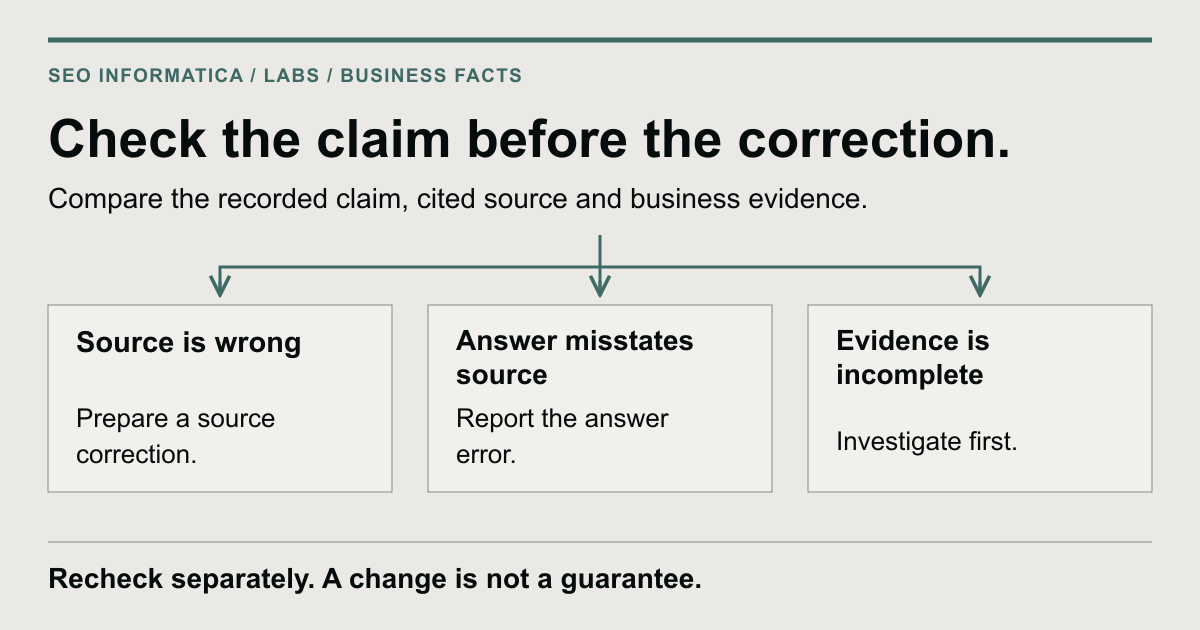
Save the answer first, then check the wrong claim against its sources. Record the question, the platform, the date and the exact words, open every page the answer cites and find the passage it relied on, then compare that passage with your current pages and, where you can, earlier versions of them. The problem may be an inaccurate source, older wording, a missing condition or a reading the evidence does not support, and each needs a different fix.
Start with something a buyer could act on: a service you do not offer, an incorrect location, a price presented without its conditions, or words attributed to your business. A disappointing recommendation is a different issue from a false fact.
The table in the next section matches what you find to a first action. Below it, three issues from our own retained records show the checks in practice, including a quotation that turned out to exist in an earlier version of our copy. To collect answers before you start, use the citation tracker.
Read the worked correction record, download its CSV, or start with the blank template.
Can I submit facts to AI models so they get my business details right?
Not directly. None of the assistants whose help pages we reviewed offers a form that writes your business details into its answers. What you can do is correct the sources you control, ask other publishers to fix their pages, and report a wrong answer through each assistant’s own feedback control.
- Sources you control: your website, your Google Business Profile and your company profiles. Fix the fact there first, with the person responsible for it.
- Other publishers: send the page owner the disputed passage and your evidence.
- The answer itself: ChatGPT and Google AI Overviews take feedback through a thumbs-down control, and Perplexity documents an error report. Feedback reports a problem. It does not edit the answer.
The route for each surface, with its source, is in the section on correction mechanisms. A corrected source or accepted feedback does not guarantee a changed answer.
What tool should I use to fix false information AI chatbots say about my business?
No tool can edit what a chatbot says. The tools that help are the editors for your own sources, such as your website and your Google Business Profile, the feedback control inside each chatbot, and a record that keeps each wrong claim with its evidence. Monitoring software can collect answers on a schedule; it does not correct them.
The correction packet below sets out what that record needs, with blank templates to download. To collect answers yourself, use our free citation tracking log. If you are comparing monitoring software, our AI SEO tools benchmark records what the products measure.
How can I tell if AI tools are pulling the wrong info from my website and how do I fix it?
Open the page the answer cites and find the passage. If your page says the wrong thing, the fix is on your page: correct it with the person responsible for the fact, then ask Google to recrawl it. If your page is right and the answer misstates it, the fix is feedback to the assistant, quoting your passage.
Check earlier versions of the page too. In our own first example, a quotation missing from today’s About page was in an earlier version of it. Keep old wording as evidence rather than restoring it to make an answer match.
Our AI Crawler Checker shows whether the crawlers behind ChatGPT, Claude and Perplexity are allowed to read the corrected page. How to request a recrawl, and what it cannot promise, is in the last section.
How to find which websites feed wrong financial data about my company to AI chatbots?
Start with the answer’s own citations: open each linked page and search it for the wrong figure. If the answer shows no sources, ask the same question in an assistant that does show them, and search Google for the exact figure in quotation marks. The pages you find are candidates, not proof: a page in a source list does not show that it supplied that number.
Then check the places that commonly publish company figures: business directories, company data profiles, old press releases and your own past pages, including archived versions. Record each page, the passage and the date you saw it.
When you find the wrong figure on a page, prepare a specific request for its publisher with the passage and your supporting evidence. Use only a figure your business has approved for publication, and never guess a replacement number to fill a gap.
Which agencies help brands correct inaccurate AI-generated information?
We do: we investigate the wrong claim, trace it to its sources, and prepare the corrections and feedback for the people who control them. No agency can make an assistant change its answer, so judge any provider, including us, by the evidence records it produces, not by a promise of fixed answers.
Our provider comparison records what other AI SEO firms publish about their work. Ask each one for a correction record like the worked example on this page: the claim, the source passage, the finding and the requested action, kept separate from any later answer.
Identify what is wrong before deciding who should fix it
A citation next to a sentence does not establish that the linked page supports the whole sentence. Open the destination, locate the relevant passage and keep its date or version. If the current passage differs, inspect an earlier version where one is available.
| What the comparison establishes | Appropriate first action |
|---|---|
| A source you control contains an incorrect business fact | Prepare a correction to that source with the person responsible for the fact. |
| Another publisher’s page contains an incorrect fact | Prepare a specific request with the disputed passage and supporting evidence for that publisher. |
| The answer uses wording found in an older source | Record the older and current versions. Investigate freshness without assuming how the answer obtained the wording. |
| A correct source is summarized without a material condition | Keep the source correct and prepare feedback showing the missing qualification. |
| The answer makes a factual claim that the reviewed evidence cannot settle | Mark it unverified and name the evidence or business owner needed to resolve it. |
| The answer expresses a preference or evaluation | Separate that opinion from any factual statements supporting it. Disagreement alone is not a factual correction. |
Treat these as working classifications. More evidence can change them. We found exactly that when we checked the first example below.
Three issues from our own answer sample
Our retained pilot includes Perplexity answers captured on 6 October 2026. This follow-up examines selected statements and source descriptions, not every claim in those answers. The original protocol, transcripts and accuracy labels remain unchanged.
Review record: prepared on 6 October 2026. No independent human fact-check is claimed. Current public pages, retained source records and our dated content history were compared. The downloadable source record identifies the material checked and its limits. No profile was edited, feedback submitted or new answer collected for this review.
1. A quotation missing today can exist in yesterday’s copy
In answer P02, the assistant attributed this wording to the site:
What does not exist yet: a wall of reviews
The initial source review did not find it on the current About page. That left an attribution question. It did not establish that the words were invented.
The follow-up found the exact words in an earlier version of our About source. The sentence appears in the version history from 2 October and was removed in a source revision dated 5 October. The current About page instead explains which case records and research readers can inspect. The downloadable record retains the historical passage, revision identifiers and dates.
Finding: historical wording identified; absent from the current About copy reviewed. That is narrower and better supported than calling it a fabricated quotation. Source-history dates are not deployment dates, and they do not establish which page version Perplexity retrieved or when.
Proposed action: if preparing feedback about the current description, provide both versions and ask for the current passage to be considered. Keep the old wording as evidence. Do not restore it to the website merely to make the answer match. The answer’s additional statements about ratings and reviews remain outside this check.
2. A starting fee does not establish an all-inclusive scope
Answer P06 uses the phrase “Transparent, all-in pricing” alongside a starting monthly fee.
Our AI SEO page gives a starting price of $1,111 a month and says that the exact fee depends on the work the business needs. The scope and fee are confirmed in the proposal. Our About page also distinguishes the ongoing plan from separately quoted website projects, and our website terms place service scope and fees in the separate written agreement.
Finding: the starting fee is supported. An unrestricted reading of “all-in” is not established by those sources. The phrase needs qualification; this review does not claim that every possible meaning of “all-in” is false or that the rest of P06 is accurate.
Proposed wording for a correction: “The plan has a starting monthly fee. The proposal confirms the work and exact fee; separately quoted website projects are another route.”
That is our proposed replacement, not a revised assistant answer. The sources already state the conditions, so changing the actual offer is not the remedy. A feedback packet should include the disputed phrase, the relevant price and scope passages, and the precise qualification requested. P06’s headquarters statement remains unverified in this review.
3. Our own public descriptions can give different starting points
The retained source sets for P02 and P06 include our company page on LinkedIn. Its readable description, checked again on 6 October, names a “Clarity Audit” and asks readers to begin with that free step. The current About page offers a direct Clarity Call or an optional written Outside View. The historical source review had already flagged differing company descriptions.
Finding: the inspected sources use different names and instructions for getting started. A company-controlled profile on another domain is still our description; it is not an independent endorsement. The presence of a profile in a retrieved source list does not prove that it supplied a particular sentence in an answer.
Proposed action: give the profile owner the two passages and proposed wording aligned with the current service routes. Have that owner confirm the wording and make any approved profile change. No profile change was made during this review, and this comparison does not establish that changing it would alter an AI answer.
This case is useful even before a later answer changes: it identifies a concrete source discrepancy we can address. It does not turn a source-maintenance task into a diagnosed model failure.
Prepare a correction packet
Use one record per disputed claim. The useful handoff contains enough evidence for another person to reproduce the comparison:
- The observation: exact question, platform, visible mode and context, date, answer excerpt and an accessible evidence reference.
- The source comparison: cited URL, exact supporting or conflicting passage, date checked, and historical version if relevant. Mark inaccessible material as unread.
- The finding: what is established, what is proposed and what remains unknown. Name the scope of the check rather than marking a whole answer accurate.
- The requested action: the correction or qualification, its evidence and the person or platform that controls the affected material.
- The follow-up: action status, publication or submission evidence if an action occurs, and a separately dated answer observation.
For the pricing example, the request can be short: “This answer labels the price all-in. The service page says the exact fee depends on the agreed work. Please retain that condition when describing the offer.” Attach the answer record and source passage so the recipient can assess it.
Do not send a folder of unrelated screenshots and expect the recipient to discover the issue. Do not turn an unverified headquarters statement into a replacement location by guessing. Ask the responsible business owner for a publishable fact when the public evidence cannot settle it.
Download the blank Markdown record or blank CSV. Both keep incomplete checks visible. They prepare a handoff; they do not send it or verify your facts.
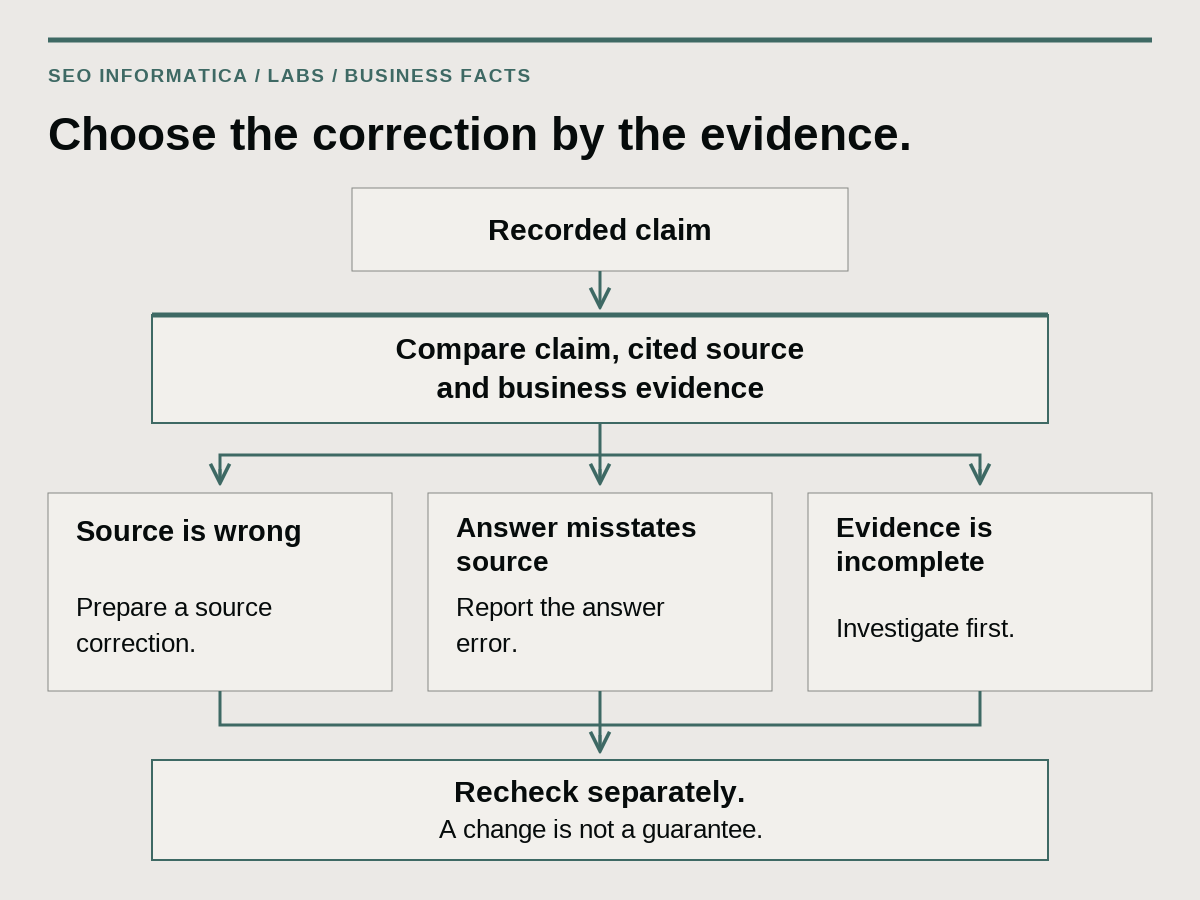
In text: compare the recorded claim, cited source and business evidence. If the source is wrong, prepare a source correction. If the answer misstates its source, prepare answer feedback. If the evidence is incomplete, investigate first. Recheck separately after any action; a change is not a guarantee.
Use the mechanism for the surface you are correcting
Google AI Overviews: Google’s help page documents thumbs-down feedback, a problem category and explanatory details. It also recommends checking supporting information. This reports an answer issue; it does not edit the source page. See AI Overviews feedback.
ChatGPT: OpenAI directs response feedback to the thumbs-down control. Its older model-feedback web form has been deprecated. OpenAI’s separate accuracy guidance recommends checking source material, including quotations. See feedback routes and accuracy guidance.
Perplexity: its official legacy support FAQ describes an error report containing the query URL, the error and the expected result. We could read that older text through the search reader, but a direct recheck failed. We have not verified the current control placement, so use the current help center to confirm the route. The legacy source is retained as dated guidance, not a tested interface instruction.
Business profiles and knowledge panels: if the wrong information is in a Google Business Profile, use the profile’s editing process. A knowledge panel has a separate feedback process, including supporting public URLs and verification requirements for representative feedback. Identify the actual surface before sending a request. These processes are not a general editor for Google’s AI answers.
These sources were reviewed on 6 October 2026. Follow their current instructions when taking action. Prepare only the information needed to establish the correction, using public evidence where possible.
Recheck without claiming a permanent fix
Keep three events separate: a source was corrected, feedback was submitted or accepted, and a later answer changed. A submission is not an accepted correction. An accepted source edit does not establish what an assistant subsequently retrieved.
For your own changed pages, Google’s recrawl documentation explains how an authorized Search Console user can request indexing. It says crawling can take days to weeks and inclusion is not guaranteed. Repeated requests do not speed up the same URL. Those are crawling limits, not a timetable for fixing an AI answer.
When comparing answers, preserve the original question and relevant context, and label any deliberate changes. Keep an answer that still contains the issue. One later correct response establishes what appeared in that attempt; it does not prove that your action caused the change or that every user will receive it.
Our review ends with a historical quotation identified, a price qualification prepared and a profile discrepancy prepared for owner review. No correction outcome is claimed. If the work reveals a section that needs clearer wording, use the answer-block writing guide to preserve the facts and conditions while improving it. If you need help investigating a documented issue, the AI SEO plan explains how we agree the work and responsibility.